It started with a couple of robins loudly calling and responding to each other, declaring their territorial claims with sweet melodic notes. They were soon joined by the fluting songs of blackbirds and as the dark receded and objects around became more distinguishable, wrens started up, dominating the area with their beautiful piercing songs, identifiable by the trilling rattles and high volume – the most decibels per gram of any bird apparently! Next in line was the chiff-chaff whose call, for which it is named, persisted throughout the time we were there.. Was it an individual or a whole gang managing to keep up the repetitive notes?
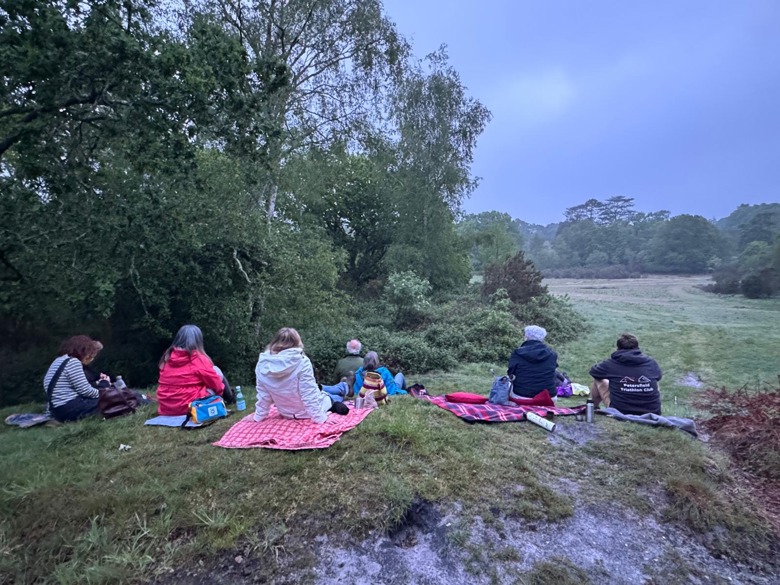
Following this, the blackcaps’ beautiful carolling song which had been previously overwhelmed by the others, came to the fore and dominated the chorus. The wood pigeon’s cooing provided the background notes punctuated by the harsh cawing of overflying crows and a pair of squawking magpies. These birds were the main participants in this year's Dawn Chorus Walk on Petersfield Heath, listened to by 13 people who were rewarded for having got out of bed so early with a beautiful building crescendo of birdsong.
The threatened rain held off, but the clouded skies possibly delayed the arrival of the tits and sparrows. Were they still in their nests or on bird feeders in gardens? Surprisingly few were heard or recorded on our Merlin apps. There were a few odd records of coal tit and more uncommonly marsh tit very early on, but sometimes Merlin has to be taken with a pinch of salt! Having said that, it is entirely possible that they were there, being drowned out by the wrens, as both these species have been recorded at the Heath.
Another record was of Cetti’s warbler, which is also known to be at the Heath, but since it wasn’t actually heard by any of the group, we have to question this too. Cetti’s warbler is a conservation success as although it is a Schedule 1 bird, meaning that it is rare and vulnerable, it has conservation status green and can now be found at many places along the South Coast. Also heard but not seen, were a goldcrest, the UK’s tiniest bird - and another very small bird, a garden warbler.
It was also lovely to see an unidentifiable bat when we arrived and then several pipistrelles, the UK’s smallest and commonest bat, which we recognised by their very small size and fast wing beat. One pipistrelle stayed out until it had become quite light and flitted around the tree tops gathering the rising insects, finally disappearing back to it’s roost for the day.
Of course, being near the pond, we heard the calls of several water birds, moorhen, mallards and coots, and were disturbed by the loud honking of a pair of Canada geese flying overhead off to graze on nearby pastures and farmland. As we made for home around the pond edge, we saw a large group of house martins high over the pond and as we walked past the reeds, we listened out for the reed warblers that we’d heard last year. They weren’t in evidence at 6.30am which was unlucky as a post on the Petersfield Photography Group Facebook page had said they were singing their hearts out just two days previously.
All agreed that it was a great way to start the day and we can recommend setting early alarms and then just opening your bedroom window. How many species can you hear, just in your garden? Kickstart your day with a chorus of joyous melodic birdsong!
If you want to know more about birdsong there are plenty of places to look on the web but I can recommend the series “Learning birdsong with Lucy Lapwing”.
Liz Bisset, PeCAN Trustee
Make sure you are up to date with the latest advice on feeding garden birds, from the RSPB