
Trustees Melanie and Greg recently visited the home of Marcus and Lindsey Matthews in the upper Causeway, where Marcus showed them around their special wild garden, which, thanks to their ‘hands off’ approach, is revealing its wild secrets.
This land stretches from the end of their back garden to the boundary of the neighbouring farmer’s field. After enquiries made to the farmer, numerous others, and the Land Registry, which showed it was unregistered and appeared to have no owner, Marcus and Lindsey began using it. Twelve years later - having installed boundary markers and a bench, planted an English oak, weeping willow, apple, crab apple and silver birches, and built a summer house - they legally claimed the land through ‘adverse possession’.
As the couple believe that wildlife - of all varieties - is as entitled to live on Earth as mankind, their intention has always been to return this 10th of an acre (0.04 ha) of land to nature.
Marcus, although originally interested in studying art, was fascinated by geology. This led him to a BSc in Engineering Geology and Geotechnics, followed by a career that took him from a master’s degree in foundation engineering to a PhD, lecturing, and research at the University of Surrey.
Over four decades as an academic, he co-authored several books on ground engineering and worked on a wonderfully varied range of projects which included: chalk compressibility, aerial photography using model aircraft - the precursor to drones - remote sensing for mapping diffuse river pollution, naturally occurring radioactive materials in Libya and Thailand, geophysical surveys, investigating dissolution features affecting abutment of a proposed bridge on the A27 Brighton bypass, and even soil-testing equipment designed for Mars.

Since retiring, Marcus has renewed his love of painting, combining it with his interest in nature and photography, and using the summer house as his studio. He also enjoys walking the lanes around Buriton and regularly helps at the village’s Repair Café.
While Marcus and Lindsey had originally hoped to create a wildflower meadow, with the ground proving too wet, they decided to encourage the return of some scrub, alongside their planting of 50 hedgerow trees - hazel, hawthorn, dog rose, rowan, blackthorn and silver birch - with some areas left clear for wildflowers and grasses and piles of rotting wood under a mature willow. Although they mow paths along those first made by wild animals, they generally leave the land undisturbed for the birds, foxes, badgers, roe deer, squirrel, occasional hedgehog, weasels, pheasants, rats, voles and mice that use it, either glimpsed or recorded on the wildlife camera. And, of course, the insects, bees and wasps which regularly drink from the bird baths.
Thanks to their intentionally overgrown cottage garden (the seed, nuts and freshwater it provides throughout the year and the wild area itself) this space provides a habitat for wrens, robins, song thrushes, blackbirds, bullfinches, chaffinches, greenfinches, long-tailed, blue, marsh, coal and great tits, dunnocks, house sparrows, nuthatches, green woodpeckers, jackdaws, rooks, wood pigeons and collared doves.
Red kites regularly fly and call overhead - and one was even seen on the bird bath, dunking its meal in the water. At night, tawny owls call and barn owls screech from the neighbouring fields.
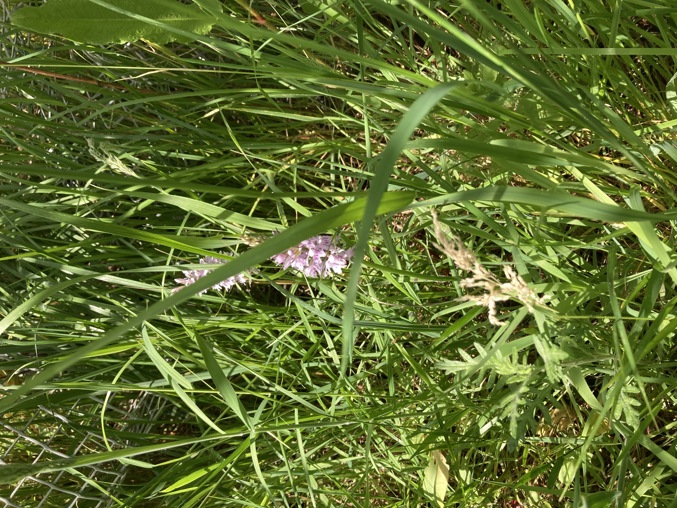
Around the English oak, several young oaks have self-seeded from a nearby hedgerow oak and in the drier areas, common spotted orchids are increasing year by year. From a seat beneath the oak, a gap in the hedgerow which is kindly maintained by the farmer, opens onto farmland and views of the hills and woodland beyond.

The result is not quite the meadow Marcus and Lindsey first imagined, but something no less valuable: a small wilderness of trees, bramble, scrub and pasture. With their neighbours sharing a similarly positive attitude towards nature, this part of Petersfield is supporting an increasingly rich diversity of wildlife.
Other than strimming pathways and planting trees, there has been little intervention. However, as the orchids continue to establish themselves, a small amount of careful management will be important to prevent bramble and scrub from shading them out. And the use of a brush cutter once a year would help maintain the open areas which could help more wild plant species make this their home.
Marcus and Lindsey take constant pleasure in the company of the birds and other creatures that share their home and have joined a growing number of Petersfield residents returning gardens and fields to nature. PeCAN will endeavour to put these people in touch with each other so they can share knowledge, methods and equipment.