
In 2019 Petersfield Town Council purchased the 35 acres of land behind the new Causeway residential development. The land cost £275,000 and the funds came from developer's premium, the Community Infrastructure Levy (CIL).
Then ensued debate and a poll in which one of three names proposed for this area was chosen: Sussex Meadow, Criddell Meadow or Goodyer Meadow, the latter winning by a small margin, in recognition of the C17 botanist John Goodyer, who came from this area.
PeCAN trustee Melanie Oxley dives into the history of this precious Petersfield green space

Entering the meadow to the left of Criddell stream, an expansive, damp, low-lying area containing approximately 10 species of grass, plus rushes and sedges, dotted through by blackthorn (sloe) and bramble (blackberry) in places. Occasional patches of meadow buttercup, lesser stitchwort and lesser spearwort were a few of the flowering plants.
This was an historical 'water meadow' or, actually, an irrigated meadow that makes use of nearby water sources and the shape of the landscape as it drains into the nearby Criddell stream. Warming water in winter and nutrient-rich sediment in summer may have travelled from Petersfield Heath pond along a deep ditch to the east of the meadow. The system comprised a series of smaller ditches ('bedworks') which dissected the site, with sluices that could allow water into the meadow (a practice called 'floating'), as well as allow it to drain out, via gravity. Some of these features can still be seen. It is important to stress that the land was not flooded as such. Standing water would kill the grass. The effect is more of a percolation, "on at a trot and off at a gallop", noted George Boswell in his leaflet on water meadows.
John Fitzherbert, Surveyor, wrote, in 1523
" . . yf there be any rynning water or lande flode that may be sette or brought to ronne ouer the medowes from the tyme that they be mowen vnto the begynning of May / and they will be moche bettr and it shall kylle / drowne / and driue awaye the moldywarpes* / and fyll vp the lowe places with sande & make the grounde euyn and good to mowe. All maner of waters be good / so that they stande not styll vpon the grounde. But especially that water that cometh out of a towne from eury mannes mydding or donghyll is worste / and will make the medowes moost rankest. And fro the begynning of May tyll ye medowes be mowen and the hay goten in / the waters wolde be set by and ron another way".
*Moldywarpes is an old english name for moles. Moles were the enemy of The Drowner because they interfered with the flow of water through damaging the bedworks

Water was allowed into these fields in winter for a period of around two weeks. The moving water prevented the land from becoming frozen and the added oxygen helped grass to start growing as early as February, providing early grazing for sheep.
This was important when we realise that between 1600 and 1900 Britain was in a grip of a mini ice-age. Long, hard winters meant the demand for winter feed was high. The sheep were taken off the meadow in April allowing the grass to grow long for the first hay crop. In May, and sometimes later in the summer, the meadow was' floated' again, but only for 1-2 days, allowing for up to three hay crops to be cut ('mowed') over the summer, to provide food for animals over the winter.
Water meadows were common in many parts of the country, from the late medieval right up to the 1800's. Goodyer Meadow most likely dates from the mid C18 when Petersfield Heath Pond was excavated. Aerial photographs can help us see the remains of these bedworks, but the wooden sluices and other pieces of infrastructure will be long gone.
Water belonged to the water-mill owners who charged farmers for abstraction. These people, through legally binding Irrigation Deeds, had a lot of power before the Agricultural Revolution which began in 1750. Another local botanist, John Worlidge (1640-1700) had been fascinated by husbandry of the land and wrote his Systema Agricultura to catalogue the improved methods of food production. He remarked that the benefit of water meadow management was threefold: Sheep could be grazed outside early in the year; sheep were taken off the water meadow to browse in grainfields, both at night in the winter and in the summer to help manure the arable crops (the sheep-corn system); and plentiful hay harvests provided both winter feed as well as an income from sales to drovers travelling with their stock to market in Portsmouth.
Today, our new Town Ranger, Jacob Gibson, has conducted a number of focus groups to debate the future purpose of Goodyer Meadow. It is hoped by all of us involved in this project that the site will be primarily managed as a nature reserve. We also dream that the water meadow can be restored to its working order once more.
Find out more below, about how you can help protect Goodyer Meadow by taking part in work parties to remove invasive plants.
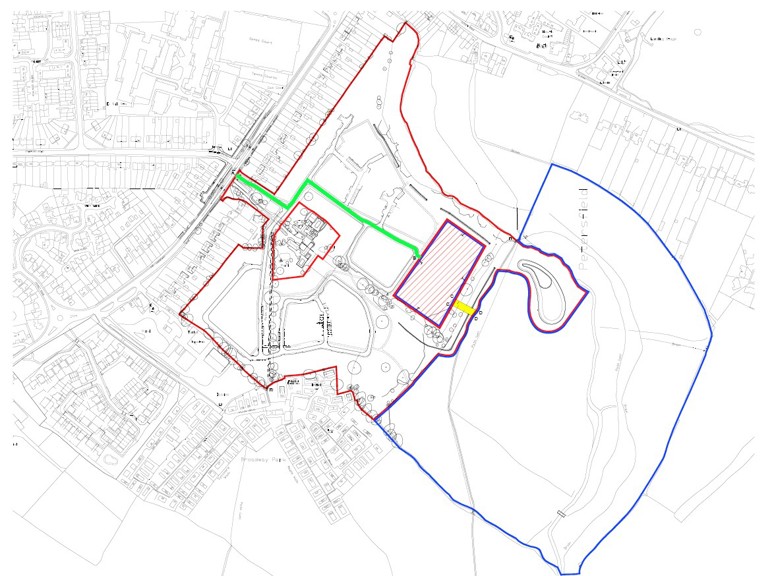
Goodyer Meadow (Causeway Field) Boundary Marked in Blue

Join a work party to remove invasive plants at Goodyer Meadows
Join volunteers from PeCAN and Western Sussex Rivers Trust to remove pretty but invasive Himalayan balsam from our waterways.
With remarkably shallow roots, it comes out with no need of tools. Just bring some gardening gloves, wear shoes/boots suitable for damp soil and uneven terrain, use insect repellant, and have arms and legs covered, in case of brambles and nettles.
This is event is a collaboration between PeCAN and Western Sussex Rivers Trust (WSRT), with help from Petersfield Town Council.
These sessions take place at both Goodyer Meadow and Rotherlands Nature Reserve. You can find times and dates below, and we invite you to email us to register.
|
Date
|
Time
|
Location
|
|
Sunday 14 June
|
13:00-15:00
|
Goodyer Meadow
|
|
Saturday 20 June
|
10:00-12:00
|
Rotherlands
|
|
Tuesday 30 June
|
9:30-12:30
|
Rotherlands
|
|
Saturday 18 July
|
10:00-12:00
|
Goodyer Meadow
|
|
Thursday 23 July
|
18:00-20:00
|
Rotherlands
|
|
Sunday 2 August
|
13:00-15:00
|
Rotherlands
|
For Goodyer Meadow we meet at the raised platform overlooking the pond, or if you are unsure how to get there, meet us 10 minutes before the session starts in the free Sussex Road carpark by Heath Pond to walk in with others. For Rotherlands Nature Reserve please park in the Penns Place car park, just past the Taro Leisure Centre, and meet on the grass at the edge of the rugby pitch. What3words: ///knee.tablets.outsmart